How to Start a Private Label Activewear Brand in 2026: Custom Logos, Labels, Packaging & MOQ Guide
Starting an activewear brand in 2026 is easier than ever—but building a profitable brand requires more than selecting trendy leggings or sports bras.
For most startups, the biggest challenge is not product design. It’s navigating hidden manufacturing costs like custom logo setup fees, labeling minimums, and packaging MOQs that can quietly destroy early-stage cash flow before your first order even ships.
To launch successfully, founders need a smarter supply chain strategy—one that combines low MOQ activewear manufacturing, startup-friendly branding systems, and scalable packaging solutions without overcommitting capital. This guide breaks down exactly how to do it.
Complete Roadmap to Start an Activewear Brand
Why Low MOQ Activewear Manufacturing Can Still Hide Major Costs
Many apparel factories actively promote a “50-piece low MOQ” for clothing production itself. However, first-time buyers rarely realize that branding layers and trims, not the fabric cutting, create the true financial barriers in private label activewear manufacturing.
When you attempt to transition a generic wholesale legging into a retail-ready branded piece, traditional suppliers hit you with standard rigid sub-component minimums. This disconnect breaks an online brand’s startup strategy before they even launch.
The Hidden Costs of Apparel Trims and Trims Logistics
To illustrate the gap between a “50-piece clothing order” and full brand customization, here is a breakdown of typical industry-standard minimums for trim accessories:
| Branding Layer | Standard Industry MOQ | Financial Bottleneck for Startups |
|---|---|---|
| Woven Neck Labels | 500 – 1,000 PCS | Forces massive upfront purchasing for tiny tags that take months or years to deplete. |
| Custom Hang Tags | 1,000+ PCS | Requires specialized printing plate setups, draining essential early-stage working capital. |
| Frosted Zipper Bags | 1,000 – 3,000 PCS | Rigid film extrusion machinery minimums trap your money in massive plastic storage. |
| Rigid Packaging Boxes | 500+ PCS | High physical volume drastically increases international shipping and local warehousing costs. |
Financial Ripple Effects for New Fitness Labels
For an e-commerce startup or niche shopify seller, cash flow velocity matters significantly more than bulk unit discounts. Forcing a startup to purchase thousands of packaging units prematurely triggers a dangerous chain reaction in your business logistics:
- Freezes Working Capital: Thousands of dollars get trapped in sitting cardboard boxes and plastic films instead of being deployed into Meta ads or Google Ads to drive sales.
- Inflates Warehousing and Storage Costs: Storing massive crates of unused hangtags and zipper bags takes up premium space or incurs unexpected 3PL management fees.
- Escalates Inventory Risk: If your first customer batch provides feedback that requires you to pivot your design, change your logo style, or update legal care labeling data, your entire stock of pre-printed packaging becomes worthless dead stock.
The Smart Startup Strategy: Decoupling Clothing and Branding MOQ
The most forward-thinking clothing manufacturers for startups help founders mitigate this specific exposure. The solution lies in decoupling structural apparel production from branding assets logistics.
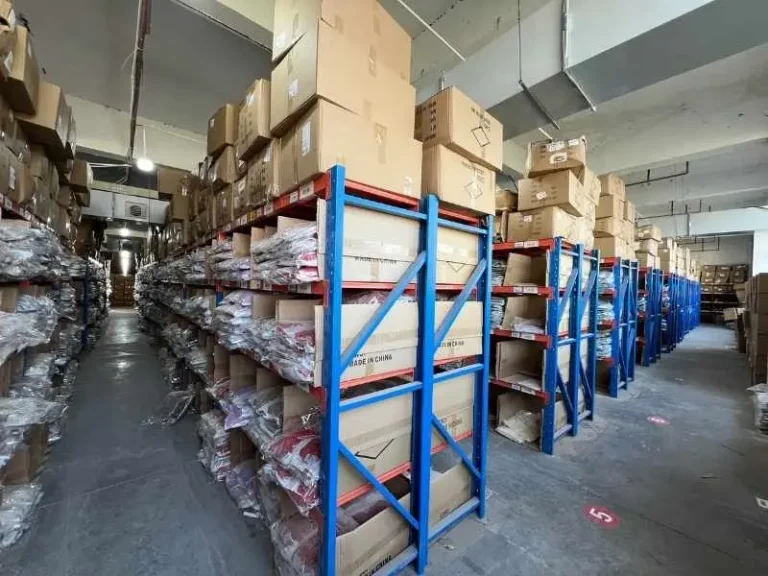
Instead of enforcing a massive flat-rate order minimum, an practical supply chain partner allows you to manufacture your garments in lean, small-batch runs (e.g., 50 pieces) while managing your high-volume custom trim stock strategically behind the scenes.
Step 1 – How to Choose the Best Activewear Manufacturer for Startups
Choosing a manufacturing partner is the single most critical decision for a new apparel line. For a startup, evaluating a supplier based on unit price alone is a fast track to failure. Premium performance wear requires specialized machinery, flexible logistics, and a deep understanding of fabric behavior under tension.
Five Supply Chain Pillars Beyond the Cut-and-Sew Price
When auditing potential private label activewear manufacturers, prioritize these five supply chain capabilities to protect your brand margins and operational agility:
- Agile Production Scaling: Look for partners offering a true 50-piece low MOQ activewear manufacturing per style/color. This allows you to test size curves and colorways in local markets without tying up vital capital.
- Comprehensive Branding Integration: The supplier must handle tagless labels heat transfer applications, woven labeling, and custom bag packing in-house. Subcontracting these steps leads to delays and high defect rates.
- Advanced Custom Logo Execution: The factory must possess heavy-duty machinery for silicone printing and specialized heat-press parameters engineered specifically for high-stretch sportswear.
- Turnaround & Sampling Speed: A startup-friendly supply chain must deliver precision prototypes within 7 to 14 days. Slow sampling cycles can cause you to completely miss seasonal market windows.
- Strategic Trim Warehousing: Ensure the manufacturer offers complimentary storage for your bulk packaging and trim inventory, allowing you to pull assets on-demand for small-batch reorders.
Strategic Blueprint: OEM vs. ODM for New Fitness Labels
Understanding the technical distinction between Original Equipment Manufacturing (OEM) and Original Design Manufacturing (ODM) determines how fast and how uniquely your brand enters the market.
| Business Aspect | OEM (Your Custom Design) | ODM (Muzyoga Design) | Strategic Impact |
|---|---|---|---|
| Design Ownership | 100% Brand Owned | Manufacturer Owned | Unique Market DNA |
| Time-to-Market | 4 – 8 Weeks (New Patterns) | 1 – 2 Weeks (Ready-to-Ship) | Agile Inventory |
| Fabric Choice | Exclusive Lab Dips | Premium Stock Fabrics | Performance Focus |
| Upfront Cost | Higher (R&D Fees) | Lower (Pre-Tested) | Risk Mitigation |
| Ideal For | Premium Performance Labels | Startups & Rapid Scaling | Long-term Growth |
The Four Essential Supply Chain Questions to Screen Suppliers
Before signing a manufacturing agreement or sending a payment for production samples, copy and paste these exact questions into your communication with the factory’s sales representative to verify their E-E-A-T and operational alignment:
- “Can your custom branding options match my 50-piece clothing MOQ without forcing massive upfront sub-component fees?” (Ensures they support decoupled trim logistics.)
- “Do you provide free warehouse storage for our bulk custom frosted zipper packaging bags and tags for future small-batch reorders?” (Verifies their capacity to act as a long-term fulfillment partner.)
- “What specific custom logo methods do you utilize for 88% Nylon / 12% Spandex fabrics to guarantee the print won’t crack or peel under 200% elongation?” (Tests their engineering competence with high-stretch performance fabrics.)
- “What is the exact price tier progression when my brand scales an individual SKU from a 50-piece launch to 500+ units later?” (Locks down future scalability margins early.)
Step 2 – Best Activewear Logo Printing Methods (Heat Transfer vs Silicone)
Activewear aesthetics are judged by how they perform under extreme tension. Unlike standard streetwear or promotional cotton t-shirts, premium fitness apparel engineered from Nylon-Spandex or Polyester-Spandex blends stretches aggressively during deep squats, high-intensity training, and yoga sessions. If your manufacturer utilizes low-grade inks or standard promotional-grade printing methods, your brand identity will literally fall apart.
The Destructive Reality of Standard Apparel Printing
When sub-par branding methods are applied to high-performance activewear, the results are catastrophic for customer retention. Poor-quality logo printing inevitably triggers three major product failures:
- Premature Cracking: Standard plastic-based inks dry rigid. The first time an athlete pulls on a sports bra or pair of leggings, the logo fractures into white lines along the fabric’s grain.
- Interfacial Peeling: Under continuous friction and heat-press temperature fluctuations in household washing machines, weak adhesive bonds degrade, causing the logo edges to curl and peel off completely.
- Severe Distortion & Wash Fading: Low-grade prints lose color saturation rapidly, leaving your brand icon looking cheap and weathered after less than five domestic wash cycles.
Premium Branding Options for High-Stretch Athleisure
To avoid these quality-control pitfalls and position your clothing line for premium retail success, you must utilize specialized printing technologies engineered to move *with* the textile fibers. Here are the two industry-standard applications recommended by the engineering team at Muzyoga:
- High-Elasticity Heat Transfer (Tagless Labels): This is the ultimate solution for next-to-skin items like leggings, bike shorts, and seamless sports bras. By leveraging advanced tagless heat transfer labels machinery, we infuse a highly flexible elastic resin directly into the fabric’s micro-mesh. The resulting transfer is completely lightweight, stretchable up to 200% without micro-fracturing, and delivers that coveted “zero-friction, tagless feel” that modern gym consumers demand. Best of all, it offers highly startup-friendly low MOQ setups.
- 3D Premium Silicone Logos: Ideal for luxury compression apparel, heavy-duty gymwear hoodies, and outerwear jackets. This method builds architectural depth by layering multiple microscopic coats of medical-grade silicone. It creates an elevated, thick raised-profile icon that remains incredibly durable, completely impervious to friction, and immediately injects an undeniable premium retail aesthetic into your collection.
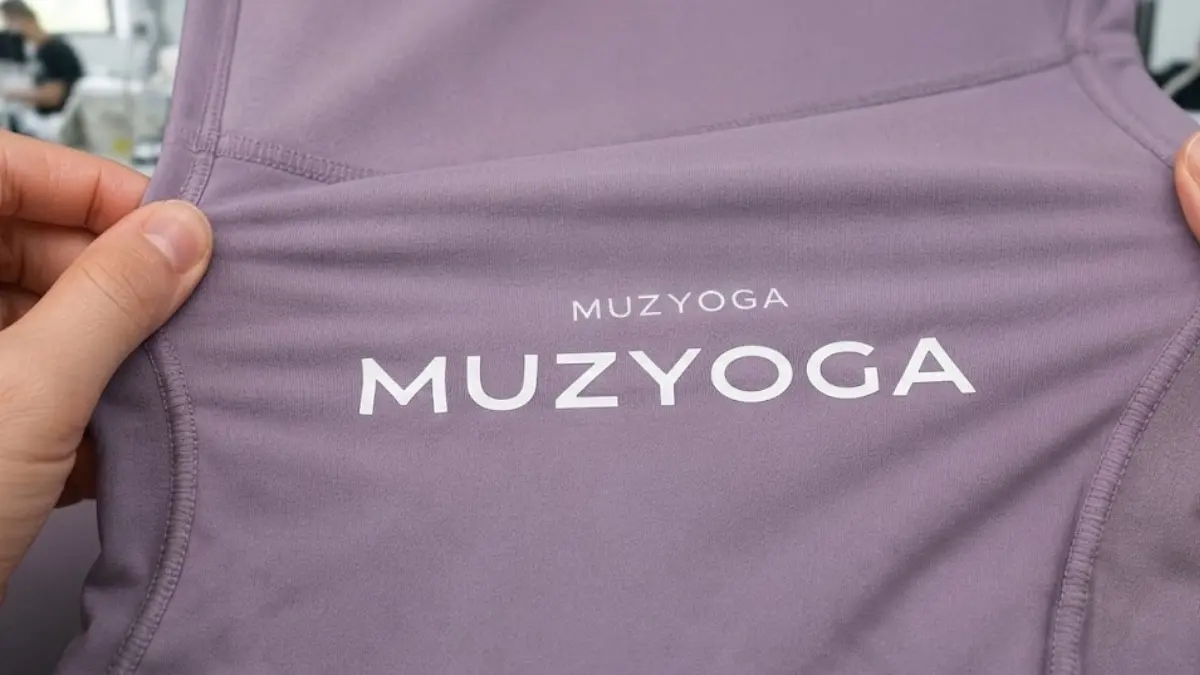 High-elasticity heat transfer logo on Muzyoga custom activewear fabric
Technical Application Matrix for Startup Procurement
To help your sourcing team make the right technical selection during your initial sampling phase, review this application framework before finalizing your tech packs:
- For Interior Branding: Always mandate tagless labels heat transfer applications for the inner neck and lower lumbar zones to replace irritating traditional woven labels entirely.
- For Exterior Branding: Utilize high-elastic heat transfers for sleek, minimalistic logos on thigh panels and rear waistbands, or deploy 3D silicone on chest plates and calf curves to make your brand identity visually pop.
Step 3 – Startup Label Strategy: Tagless vs Woven Labels
For high-performance sportswear, functional engineering extends right down to how you displays legal fabric care compliance and size metrics. First-time clothing founders often spend months perfecting custom patterns and fabric blends (such as 75% Nylon / 25% Spandex), only to sabotage the entire premium user experience at the last minute by installing abrasive, traditional branding assets.
Why Traditional Sewn Labels Can Severe Damage Your Brand Experience
Modern athleisure consumers, particularly luxury yoga practitioners and gym-goers, demand a “second-skin, zero-distraction” feeling. Standard, stiff woven nylon loops sewn directly into the rear waistband or side seams are a massive liability. In a highly competitive e-commerce landscape, scratchy interior labels directly trigger three severe business risks:
- Chronic Skin Irritation: Repetitive friction against sweaty skin during intense cardio or yoga flows causes chafing and redness, alienating your core customer base.
- Spike in Return Rates: Consumers will quickly return an expensive pair of gym leggings if the internal trim compromises their physical comfort during their initial try-on.
- Devastating One-Star Reviews: Modern consumers do not hesitate to voice their frustration on Shopify product pages or social media platforms if a premium-priced activewear piece scratches them, instantly destroying your conversion rate optimization (CRO) efforts.
The Startup-Friendly Labeling Matrix for practical Performance Wear
To scale your branding infrastructure without breaking your bank, you must choose a labeling application aligned with both your financial capacity and consumer expectations. Review this comparative trim matrix implemented for global clients at Muzyoga:
| Label Type | Best Use Cases | Typical MOQ Strategy | Key Operational Advantage |
|---|---|---|---|
| Tagless Heat Transfer | Inner necks, lower lumbar, sports bra waistbands | Matches 50-pcs garment MOQ | Eliminates all skin friction; creates a sleek, seamless sensory experience. |
| Woven Label | Exterior brand patches on hoodies or jacket cuffs | Medium MOQ (300+ pcs) | Adds tangible dimensional texture, reinforcing a luxury heritage brand appearance. |
| External Hang Tag | Detachable retail branding & mandatory price placements | Bulk plate print (500+ pcs) | The primary canvas for your eco-friendly brand storytelling and sizing transparency. |
The Ultimate Beginner Choice: Deploying Tagless Infrastructure First
For independent fitness label startups launching their first core collection, utilizing tagless labels heat transfer technology is the most optimal operational decision. It provides the ultimate triad of strategic benefits:
- Frictionless Low MOQ Commitments: Because elastic transfers can be printed and stored on compact release papers, an practical supply chain partner can apply them on-demand to match your 50-piece lean apparel production run without wasting money.
- Uncompromised Performance Comfort: Your customers experience a completely flat surface with zero itching, making your garments immediately competitive against market titans.
- Premium, Clean Retail Presentation: Sleek inner-neck prints signal to high-end buyers that your label understands professional activewear garment construction, boosting early-stage brand equity.
Step 4 – Smart Activewear Packaging Without High MOQ Risk
The premium unboxing experience is the final touchpoint that solidifies your brand equity. Many independent clothing founders mistakenly believe that if their premium performance garments are structurally flawless, they can skimp on presentation. However, forcing an upscale 75% Nylon / 25% Spandex legging into a generic, flimsy plastic sleeve can instantly destroy your perceived value during consumer unboxing.
The Crucial Psychology Behind Premium E-commerce Presentation
For direct-to-consumer (DTC) activewear brands, your shipping package is your physical storefront. Utilizing cheap, industrial packaging signals to the consumer that the product inside is generic wholesale stock, leading to severe brand friction. Investing in practical presentation pays massive dividends across your three core business metrics:
- Drives Social Media Virality: High-end aesthetic packaging encourages organic “unboxing reels” on Instagram and TikTok, driving free viral traffic to your store.
- Justifies Premium Retail Pricing: When a consumer touches heavy-duty, customized materials, their brain instantly validates a higher price tier ($80+ per SKU).
- Minimizes Product Damage: Professional-grade, moisture-resistant barriers protect technical apparel trims from dampness and friction during international transit.
Strategic Packaging Comparison for Startup Apparel Operations
To avoid over-allocating capital into heavy plastic production runs early on, you must evaluate bag materials based on both aesthetic prestige and asset liquidity. Review this operational roadmap utilized by top-tier global scaling labels:
| Packaging Type | Brand Impression | Startup MOQ Risk | Best Strategic Use |
|---|---|---|---|
| Standard Clear Polybag | Low / Industrial Feel | Extremely Low (No Risk) | Basic internal factory sorting only; not recommended for consumer-facing shipments. |
| Frosted Zipper Bag | Premium / Luxurious Reusable | High Machinery MOQ | The absolute industry standard for professional athleisure. Delivers practical tactile presentation. |
| Recycled Packaging | Eco-Friendly / Sustainable Positioning | Very High (Material sourcing limits) | Perfect for green-marketing campaigns targeting eco-conscious fitness consumer cohorts. |
The Low-Risk Warehousing Model: Batch Trim Production
To completely bypass the high upfront cost barriers of 500-piece plastic minimums while enjoying a lean 50-piece activewear clothing launch, smart brands leverage the decoupled trim logistics infrastructure offered by Muzyoga:
- Unlock Bulk Unit Cost Savings: By batch-producing 500 customized custom frosted zipper packaging bags upfront, your brand secures the lowest possible per-unit manufacturing price tier.
- Keep Apparel Launches Agile: Instead of shipping 500 empty bags across the world, our factory stores your bulk packaging trim inventory in our clean, secure warehouse entirely free of charge.
- On-Demand Small-Batch Pulls: When you issue a lean 50-piece apparel reorder or launch a new experimental colorway, our assembly line pulls 50 customized bags directly from your reserved trim stock, seals your garments, and ships them ready for retail.
- Maximize Working Capital Velocity: This model ensures your immediate cash reserves remain liquid for paid ad campaigns, product validation.

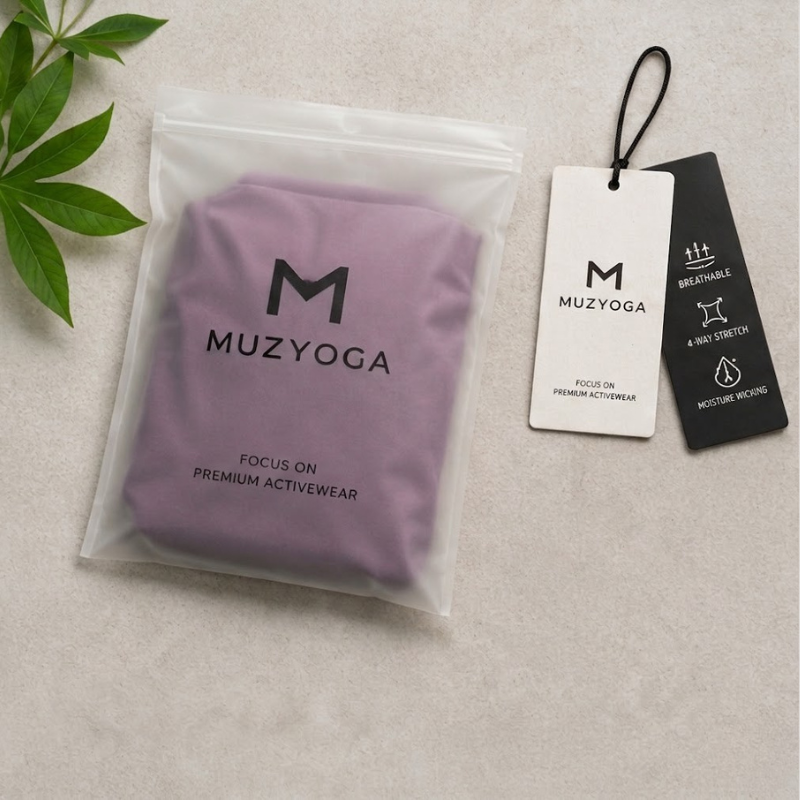 Premium custom frosted zipper packaging bags paired with thick, tactile brand hang tags.
Step 5 – Budget Blueprint for Launching an Activewear Brand (50–300 PCS)
Launching an apparel brand doesn’t require a six-figure capital allocation if you structure your supply chain logistically. By separating your raw garment manufacturing from your long-term branding assets, you create a lean, highly liquid financial ecosystem that allows your business to pivot, test, and scale based on real-time market data.
To give independent founders a clear operational roadmap, here is the exact cash-velocity breakdown implemented for our strategic growth partners at Muzyoga:
| Branding Layer | Startup-Friendly Approach | Capital Risk |
|---|---|---|
| Clothing Production | 50 – 300 PCS per individual style / colorway | LOW RISK |
| Tagless Logo Placement | On-demand heat transfer pressing during fulfillment | VERY LOW |
| Woven Branding Labels | Batch order deferred to secondary seasonal scaling phase | MEDIUM |
| Custom Packaging Bags | Bulk batch printing combined with complimentary factory storage | CONTROLLED |
⚠️ The Golden Rule for Startup Fashion Labels:
“Focus your early-stage energy and capital entirely on proving your product-market fit, not on over-optimizing industrial-scale customized packaging infrastructure.”
Your early conversion tracking data doesn’t care if your box cardboard has a matte laminate coat; it cares if your custom yoga leggings hold a perfect silhouette during a workout, lift the glutes elegantly, and deliver absolute sensory comfort. Keep your capital agile, get your 50-piece collection online, gather raw user reviews, and utilize your manufacturing partner’s warehousing infrastructure to scale your assets systematically as your organic traffic grows.
Common Mistakes New Activewear Brands Make (And How to Avoid Them)
Navigating the global clothing supply chain is a minefield for emerging sportswear labels. Even with high-performing designs and a strong local digital marketing strategy, tactical oversights during your initial factory-sourcing phase can permanently derail your gross profit margins. Below are the three fatal execution errors frequently observed by our engineering and logistics teams.
Mistake 1 – Evaluating Potential Suppliers by Clothing MOQ Alone
Many new athleisure founders filter factories using a single baseline metrics: *“What is your minimum clothing production run?”* While securing a 50-piece or 100-piece clothing production cut is essential for testing market velocity, it only covers one fraction of your actual physical product rollout.
To avoid severe supply chain bottlenecks before launch, your sourcing team must proactively ask these critical sub-component questions during early negotiations:
- “What is your factory-direct MOQ for tagless labels heat transfer roll printing, and can it be integrated smoothly into a 50-piece garment run?”
- “What are the precise minimum plate-setup fees for custom-printed
custom frosted zipper packaging bags?” - “Does your facility handle the final branding layers, folding, and trim tag application in-house, or do you outsource to external logistics providers?”
Mistake 2 – Overinvesting in Luxury Packaging Configurations Too Early
Brand positioning and premium presentation undeniably matter for e-commerce conversion rates. However, operational survival and cash flow velocity must always come first. Pouring thousands of dollars into heavy, luxury-laminated rigid boxes or customized corrugated shipping mailers during your first 50-piece product validation phase freezes critical capital.
The Strategic Pivot: Utilize our decoupled trim logistics model. Produce lightweight, high-end frosted zip-lock bags in bulk to secure rock-bottom unit costs, and leverage our complimentary warehouse space to pull them on-demand for small, fast-turning activewear production cycles.
Mistake 3 – Ignoring Technical Fabric-Logo Printing Compatibility
Standard printing methods utilized for graphic streetwear or low-performance promotional goods—such as standard screen printing with plastisol inks—cannot survive the mechanical tension of practical activewear textiles. High-stretch fabric blends like 75% Nylon / 25% Spandex or heavy seamless knits stretch aggressively during high-intensity training.
If you ignore fabric-logo engineering compatibility, your brand icons will fracture, peel, and flake off after a handful of wash cycles. To retain practical customer loyalty and maintain a premium retail aesthetic, always mandate specialized **high-elasticity heat transfers** or **3D silicone prints** that move fluidly with the textile fibers under tension.
The Sustainable Branding Advantage: Differentiating Your Activewear Line
Eco-conscious production has officially shifted from a premium niche marketing angle to a core consumer requirement. Modern fitness consumers and athleisure buyers actively scrutinize the environmental footprints of the apparel they purchase.Our raw materials meet international compliance standards including OEKO-TEX, GRS, and BSCI. You can also read our guide on sustainable fabric article and learn about Low MOQ Activewear Manufacturing
Four Green Pillars Modern Athletic Consumers Scrutinize
When positioning your activewear collection to capture high-margin retail segments, your supply chain should actively evolve to support these four sustainable pillars:
- Recycled Performance Fabrics: Shifting away from virgin polyester to high-grade certified recycled nylon blends derived from ocean waste or post-industrial textile scraps, delivering the exact same signature buttery-soft compression feel.
- Next-Generation Bio-Based Nylon: Utilizing advanced plant-derived eco-polymers that reduce carbon footprints during initial fiber extraction without compromising the fabric’s tensile strength or 4-way stretch longevity.
- Compostable & Eco-Friendly Packaging: Replacing rigid single-use petrochemical plastics with marine-degradable or fully
compostable packagingbags that dissolve naturally back into the soil without leaving toxic residues. - Minimalist, Zero-Waste Trims: Stripping away redundant structural layers in favor of streamlined, ultra-thin recycled-paper hang tags and tagless heat-press identification systems.
The Startup Dilemma: Green MOQs vs. Practical Resource Allocation
The true bottleneck for a startup fashion business is that raw eco-certified textiles and biological polymer extrusion lines usually require massive industrial production minimums. To help you navigate this transition sustainably without freezing vital cash flow, review the low-risk framework utilized by the sourcing team at Muzyoga:
| Eco Component | Traditional Minimum Barrier | Muzyoga Low-Risk Strategy |
|---|---|---|
| Recycled Fabrics | 500+ kg per custom dye lot | Utilize premium, pre-certified eco-stock fabrics to access a true 50-piece startup launch. |
| Compostable Bags | 2,000+ pcs for blowing machine minimums | Batch-print bags early to lock down low unit prices, then leverage our free trim storage to pull as you grow. |
| Minimalist Labels | Varies by factory capability | Deploy tagless heat transfer markings to replace woven waste completely, aligning with an zero-friction ethos. |
By blending sustainable storytelling with smart, decoupled trim logistics, you elevate your brand beyond generic wholesale competition. You give conscious buyers a powerful moral justification to purchase from your label while maintaining the lean, tactical cash reserves necessary to scale your digital presence.
How Muzyoga Supports Startup Activewear Brands
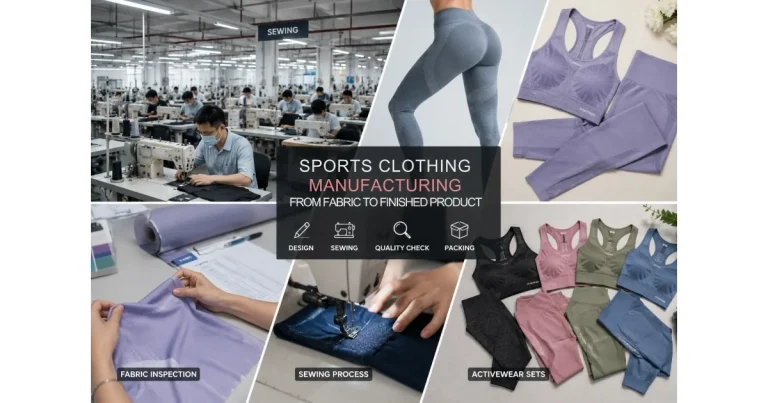
Sourcing your collection shouldn’t be an operational bottleneck. True manufacturing efficiency is not merely about stitching pieces of stretch fabric together; it is about engineering a comprehensive, modern production ecosystem that systematically eliminates supply chain friction, protects your early-stage cash flow velocity, and scales dynamically with your business growth.
We have re-engineered the traditional heavy-factory infrastructure into an agile, private label incubator. We provide the complete technical, structural, and logistical blueprint necessary to transform independent design concepts into premium, market-ready performance wear:
- Agile Low MOQ Production Ecosystem: Access highly premium garment construction with a lean, startup-friendly 50-piece production run per style/colorway, allowing you to validate niche market demand with near-zero inventory overhead liabilities.
- End-to-End OEM/ODM Flexibility: Whether you supply exact technical specification patterns for completely bespoke cut-and-sew apparel (OEM) or select from our verified catalog of trend-forward, high-performance ready-to-ship activewear silhouettes (ODM), our engineers deliver absolute precision.
- Advanced Fabric-Logo Engineering: Protect your brand equity with high-durability 3D silicone applications and 200% elasticity heat-transfer capabilities engineered specifically to stretch without cracking or peeling on high-tension Nylon-Spandex textiles.
- Seamless Tagless Heat-Transfer Labeling: Replace abrasive, traditional interior woven loops with sleek, zero-friction tagless labels heat transfer applications for optimal next-to-skin sensory comfort, immediately maximizing your post-purchase customer retention rates.
- Premium Woven Exterior Accents: Deploy highly tactile, crisp structural woven tags on heavy fleece hoodies, jacket trim panels, or lifestyle athleisure outerwear to elevate your luxury heritage brand aesthetic.
- Decoupled Smart Packaging Strategy: Break free from high machinery minimums. Secure rock-bottom per-unit pricing by batch-producing your custom frosted zipper packaging bags upfront, while leveraging our secure, climate-controlled factory warehouse to store and fulfill your packaging on-demand for small garment runs entirely free of charge.
- Eco-Certified Sustainable Fabric Integration: Align seamlessly with modern eco-conscious consumer cohorts by choosing from our extensive inventory of premium recycled nylon and certified ocean-bound waste performance textiles.
💡 The Bottom Line For Modern Procurement Managers:
“For high-growth independent startups, scaling athleisure brands, and practical wholesale distributors, selecting the ideal activewear manufacturing system is never just about acquiring finished products—it is about permanently reducing your operational friction and out-pacing the competition on supply chain velocity.”
Conclusion
Starting an activewear brand in 2026 is no longer just about product design—it is about navigating the hidden economics of branding, manufacturing, and supply chain flexibility.
The brands that succeed are not always the ones with the biggest budgets, but the ones with the smartest launch strategies.
By understanding MOQ traps, choosing the right manufacturer, and building scalable branding systems, startup activewear brands can launch faster, protect capital, and grow sustainably.
FAQ: Starting a Private Label Activewear Brand in 2026
To help sourcing managers and independent fashion startup founders streamline their procurement timelines, our engineering team has compiled direct, technical answers to the most frequently asked industry questions regarding activewear manufacturing and trim supply chains.
Q1: Can I legitimately start a premium activewear brand with an initial order of only 50 pieces?
A: Yes, absolutely. Agile tier-one manufacturers offer a 50-piece low garment MOQ per style/colorway to help brands run lean validation tests. However, the critical trap is assuming this 50-piece limit applies to everything. You must always negotiate and confirm the raw minimums for sub-component layers—such as customized logos, compliant care labels, and customized packaging bags—separately before transferring your initial sampling deposit.
Q2: What is technically the best logo printing option for startup legging and sports bra brands?
A: Advanced high-elasticity heat transfer (or tagless heat transfer) is the most optimal setup for high-stretch athleisure. Because activewear textiles like nylon-spandex stretch aggressively during deep squats, standard screen prints will fracture and peel. High-elastic transfers bind micro-flexible resins directly into the fabric’s knit fibers, offering up to 200% elongation, a sleek zero-friction feel, and highly startup-friendly low MOQ plate setups.
Q3: Are traditional sewn woven labels legally or structurally necessary for a brand launch?
A: Not at all. In fact, traditional woven loops inside fitness gear are heavily disliked by modern consumers because they scratch the skin and cause friction chafing during high-intensity workouts. Utilizing modern heat transfer labels applications prints mandatory country-of-origin, sizing, and care tracking data directly onto the inner lumbar or neck fabric mesh. This slashes upfront trim manufacturing costs while maximizing user sensory comfort.
Q4: How can a bootstrapped activewear label avoid high custom packaging bag MOQs?
A: The smartest approach is to utilize a decoupled batch production and storage model. Instead of overpaying for generic packaging or freezing massive sums in small-run prints, you can batch-manufacture 1,000 premium custom frosted zipper packaging bags upfront to secure the lowest volume unit price tier. Then, partner with an agile factory like Muzyoga that provides complimentary trim warehouse space, pulling only 50 or 100 bags at a time to match your lean apparel product drops.
Q5: During an early brand rollout, what requires more capital priority: retail packaging or garment quality?
A: Absolute product quality, structural fit accuracy, and clear identity branding must always take absolute priority over extensive packaging investments. Your target audience will never return to buy from your store based on a cardboard box; they return because your yoga pants provide a flawless silhouette, non-see-through squat proofing, and practical tactile comfort. Keep your packaging lean and protective, focus your capital on fabric performance validation, and scale up your presentation scale as your revenue scales.
Launch Your Activewear Brand Without Hidden MOQ Traps
Whether you’re building a Shopify fitness label, boutique gymwear collection, or scaling wholesale activewear business, Muzyoga helps founders reduce startup risk through flexible low MOQ production, scalable branding systems, and practical packaging logistics.
Send us your logo, design concept, or sourcing plan today to get a startup-friendly production roadmap tailored to your brand goals.