How to Compare Activewear Fabric Options Before Sampling
A supplier sends you six activewear fabric swatches. Three feel good. Two have almost the same fiber content. One is noticeably softer, while another feels firmer and more supportive.
Which ones are actually worth turning into garment samples?
For an activewear brand, that is the useful fabric-selection question. The answer does not come from choosing the highest GSM, the largest spandex percentage or the fiber with the best marketing story. Start with the product you are trying to build, compare every candidate against the same requirements, and remove the fabrics that pull the product in the wrong direction.
A practical fabric-selection path
Define the garment
→
Compare fabrics for the same job
→
Remove poor matches
→
Shortlist two or three candidates for sampling
Start With the Garment You Are Trying to Build
“Send me your best yoga fabric” sounds convenient, but it leaves too much of the product decision to the supplier.
A soft Pilates legging and a firm gym legging can both use stretch knit fabric, yet they are not asking for the same result. One may need a softer matte surface and easier movement. The other may need a denser hand and stronger hold.
A running top changes the priorities again. Low weight, ventilation and moisture handling matter more than the brushed hand that may suit studio wear.
Before looking at fiber names, make the product direction clear.
| Product | Target feel | Fabric priorities |
|---|---|---|
| Yoga / Pilates leggings | Soft, matte, close to skin | Multi-directional movement, recovery, coverage and handfeel |
| Gym / training leggings | Firmer, more structured | Controlled stretch, stability, coverage and surface durability |
| Running / HIIT top | Light, smooth, less clingy | Low weight, movement, ventilation and moisture-management construction |
| Sports bra | Smooth or soft with defined support | Stretch control, recovery, coverage and compatibility with the bra construction |
The same principle applies whether a supplier calls the category activewear fabric or sportswear fabric. The product comes first. The fabric is chosen to serve it.
You can see how different fabric directions are used across our women’s activewear collection, including sports bras, training tops, leggings and other styles developed for different movement, handfeel and product requirements.
Ask for Fabric Options You Can Actually Compare
Once the product direction is clear, ask the supplier for several fabrics aimed at the same job.
Instead of asking for “premium yoga fabric,” for example, ask for options suitable for a soft studio legging with a matte surface, medium support and four-way movement.
Each candidate should come with the same basic information where available:
- fabric code or swatch reference;
- fiber composition;
- GSM;
- knit or construction information;
- surface finish or handfeel direction;
- stretch direction;
- available colors or finishing options relevant to the style;
- availability for the intended development and production route.
This creates a fair comparison. If Fabric A has a complete specification but Fabric B is described only as “buttery soft,” you are not yet comparing the same information.
Compare the Swatches Side by Side
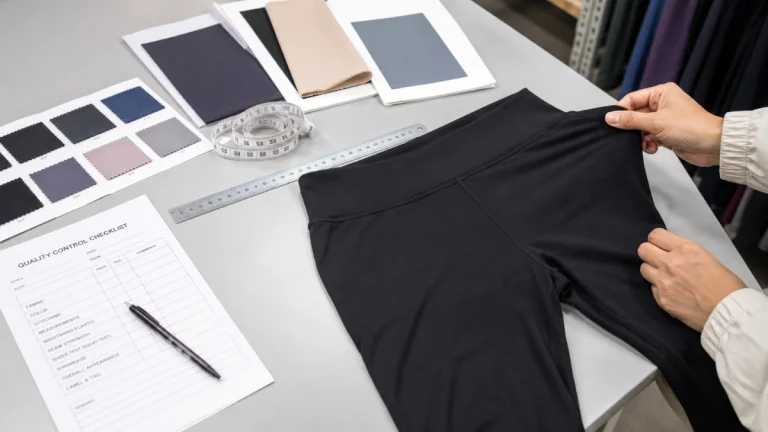
Do not review one fabric today and another several days later. Put the candidates together and compare them against the original product goal.
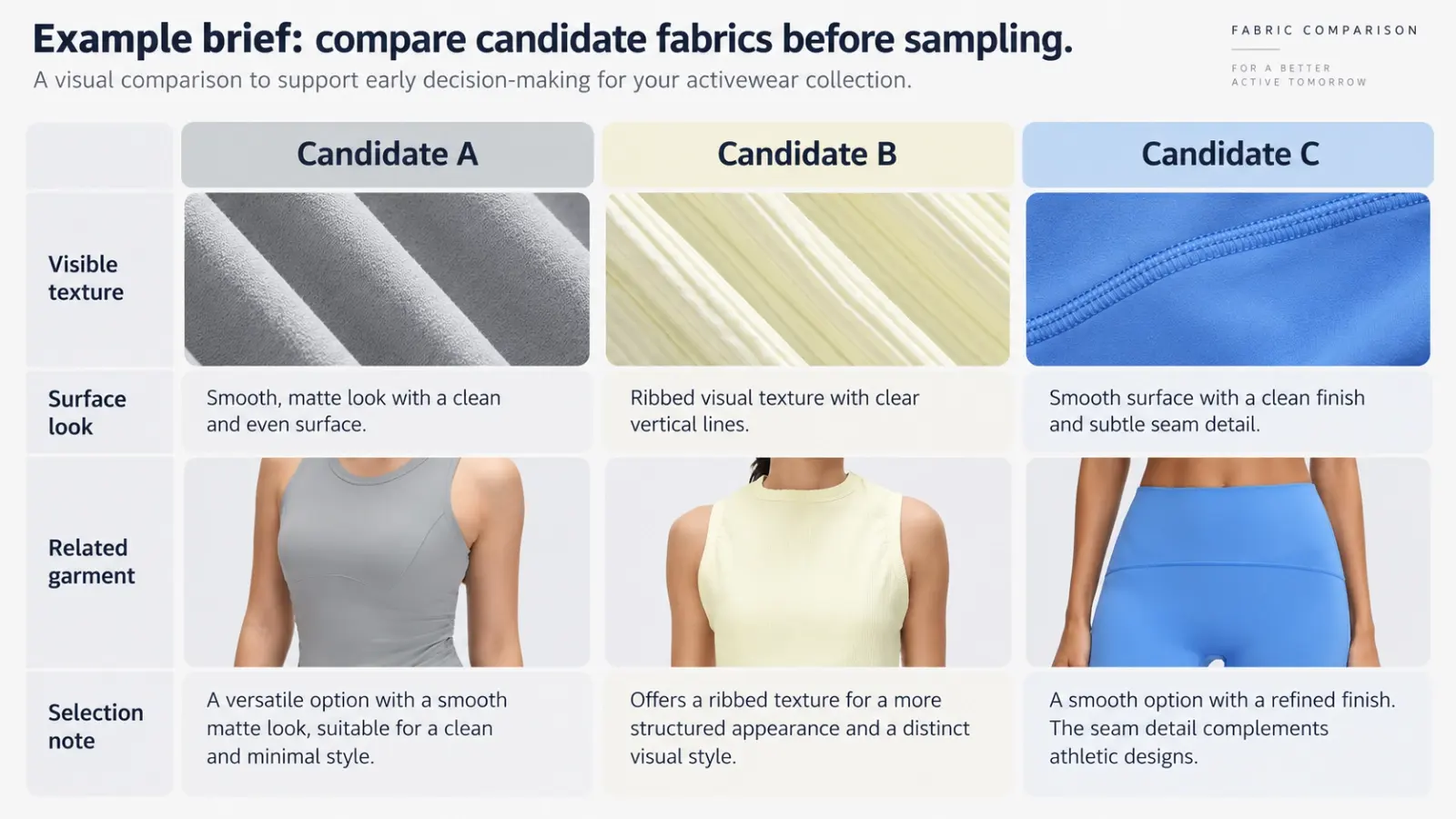 Compare candidate fabrics against the same product goal instead of judging one specification in isolation.
Consider a brand developing a soft yoga and Pilates legging. A supplier proposes three possible fabrics:
| Comparison | Candidate A | Candidate B | Candidate C |
|---|---|---|---|
| Fiber direction | Nylon / spandex | Nylon / spandex | Polyester / spandex |
| Weight direction | Medium | Medium to heavier | Medium |
| Surface | Soft, brushed, matte | Smooth, dense, matte | Smooth, more technical |
| Stretch direction | Four-way | Four-way | Four-way |
| What changes in the product | Closest to a soft studio feel | Moves toward firmer support | Moves toward a more technical performance feel |
| Shortlist decision | Keep | Keep if a firmer alternative is useful | Remove if softness is non-negotiable |
Candidate C is not a bad fabric. It simply changes the product direction.
That distinction is important. A fabric can be technically suitable for activewear and still be wrong for the garment you are developing.
A good fabric can still be the wrong fabric for this product.
Read Fabric Specifications as Signals, Not Scores
Specifications help explain why two fabrics feel and behave differently. They should not become a scoring system where the largest number wins.
| Specification | What it helps you compare | What it does not prove by itself |
|---|---|---|
| Composition | Fiber direction and blend | Final handfeel, support or overall quality |
| GSM | Relative fabric weight | Opacity, compression, recovery or quality |
| Stretch direction | How the fabric moves along its main directions | How well it returns after stretching |
| Knit construction | Structure, density and how the material is built | Finished-garment fit on its own |
| Surface finish | Touch, appearance and product character | Complete garment performance |
The useful decision comes from reading these properties together, not ranking one number in isolation.
For example, two fabrics can both be nylon-spandex and both be four way stretch fabric, yet one can feel soft and brushed while the other feels compact and firm. That difference can matter more to the product than the fact that both share the same broad fiber category.
If your choice has narrowed to two very different material directions, our Lyocell vs Polyester for Activewear comparison looks more closely at how material direction changes with the intended use.
Separate Product Requirements From Flexible Specifications
One of the easiest ways to slow down development is to lock technical numbers too early while leaving the customer-facing result vague.
Suppose the product promise is a soft, matte yoga legging. The soft surface may be non-negotiable. The exact workable GSM may still be open while you compare two suitable constructions.
For a firmer training tight, support and shape retention may be the fixed requirements. The sourcing team can still compare more than one blend or weight if both routes serve that goal.
Use one question to separate the two:
If this specification changes, does the customer receive a noticeably different product?
If the answer is yes, treat it as a product-defining requirement.
If several fabric routes can still deliver the same intended experience, leave room to compare them before locking the specification.
Shortlist Fabrics That Answer a Real Product Question
More swatches do not automatically create a better decision.
Once several fabrics meet the basic product direction, keep the candidates that provide a meaningful comparison:
- soft versus firmer;
- brushed versus smooth;
- lighter versus more substantial;
- one fiber direction versus another;
- two constructions that aim for a similar handfeel in different ways.
Two nearly identical fabrics do not both need to become garment samples unless there is a real commercial or technical reason to compare them.
For an initial development round, reducing the choice to two or three clearly identified candidates keeps the next step focused. Record the exact fabric code or swatch reference so the supplier, sample room and brand team are all discussing the same material.
A fabric deserves a place on the shortlist when:
- it still matches the original product direction;
- it offers a meaningful difference from the other candidates;
- its reference and basic specifications are clear enough to identify the same fabric later.
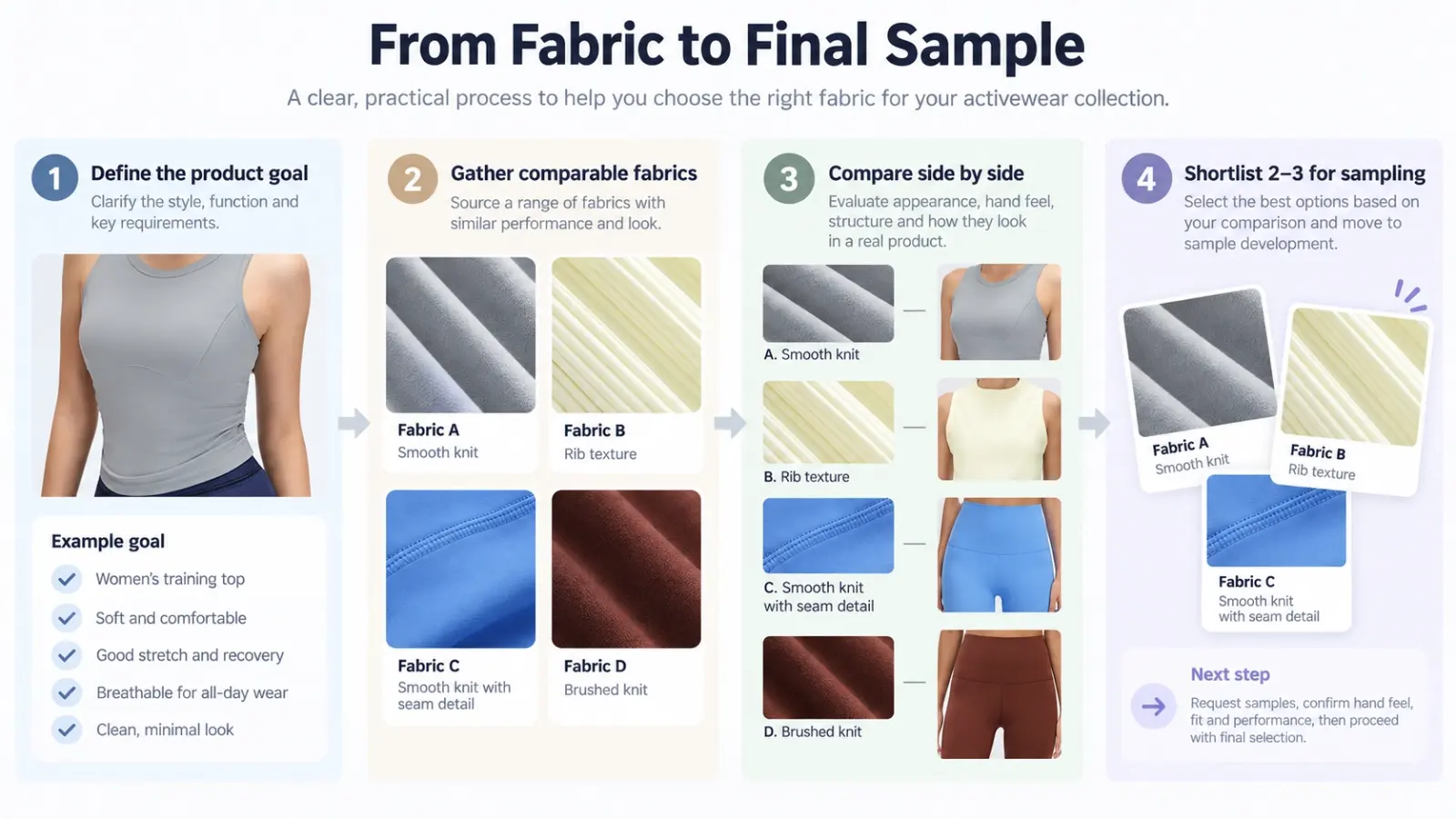 Define the product goal, compare comparable fabrics, then shortlist two or three candidates for garment sampling.
Move the Shortlist Into Garment Sampling
A swatch can tell you a great deal about touch, surface, weight and basic stretch. It cannot show the complete result once pattern, seams, waistband, lining and fit are added.
After the shortlist is down to two or three credible options, the next useful comparison happens in the garment itself.
Fit, movement, opacity and recovery can then be reviewed through the activewear sampling process instead of being predicted from a loose piece of fabric.
That also gives the development team a clear reason for every sample. One version may test the softer fabric, another the firmer alternative. The sample is answering a product question rather than repeating the same design in several nearly identical materials.
Frequently Asked Questions
What is the best fabric for activewear?
There is no single best fabric for every activewear product. Start with the garment and intended customer experience. A soft yoga legging, firm training tight, lightweight running top and sports bra need different combinations of handfeel, weight, stretch, construction and support.
What is the best fabric for workout clothes?
Match the fabric to the activity and garment. Studio products may prioritize softness and unrestricted movement, while running or training tops may place more emphasis on low weight, ventilation and moisture-management construction. For product development, compare the finished fabrics rather than choosing from the fiber name alone.
Is nylon or polyester better for activewear?
Neither is universally better. Nylon- and polyester-based fabrics can both work well in activewear. The stronger option is the finished fabric that gives the intended handfeel, structure, stretch and appearance for the specific product.
What GSM is best for activewear?
There is no single GSM that is best for all activewear. GSM describes fabric weight per unit area. Use it to compare candidate fabrics for the same product, then consider construction, surface feel and the intended garment direction before deciding.
Does more spandex mean better support?
No. Spandex percentage is only one part of the fabric. Knit structure, yarn arrangement, weight and finishing also affect how the material stretches, feels and returns.
How many fabric options should a brand compare before sampling?
Enough to compare meaningful differences, but not so many that development becomes an open-ended swatch search. Two or three clearly different, well-matched candidates are usually more useful than a large group of nearly identical fabrics.
Choose the Shortlist, Then Let the Garment Make the Final Decision
The strongest activewear fabric is not the one with the highest GSM, the most spandex or the longest specification sheet.
Start with the product. Compare every candidate against the same goal. Keep the options that preserve the intended feel and function, and remove the ones that quietly turn the product into something else.
Once two or three credible fabrics remain, stop collecting swatches and move forward with garment sampling.
Preparing a new yoga, gym or activewear style?
Send Muzyoga your product reference, intended activity, target handfeel, planned quantity and any fabric direction you already have. We can narrow suitable fabric options before the first garment sample.