Lyocell vs Polyester for Activewear: Which Fabric Should Your Brand Choose?
Lyocell and polyester can both be used successfully in activewear, but they are not solving exactly the same problem.
Think about the difference between a soft Pilates set and a technical running top. One spends most of its time in controlled studio movement and close contact with the skin. The other may need to stay light through an hour of heavy sweating. It makes little sense to judge both fabrics by the same standard.
For yoga, Pilates and softer studio apparel, Lyocell-based stretch fabrics deserve serious consideration. When rapid drying and sustained high-output exercise move to the top of the list, polyester usually becomes the stronger starting point.
That still does not make the fiber name the final answer. Blend, GSM, knit construction, stretch and recovery can change the finished garment enough that two fabrics described as “Lyocell” may feel and perform very differently.
Is Lyocell or Polyester Better for Activewear?
Start with what the garment needs to do.
| Product priority | Better starting point | Reason |
|---|---|---|
| Yoga and Pilates | Lyocell-based stretch fabric | Soft handfeel and moisture absorption suit many studio products. |
| Soft next-to-skin feel | Lyocell | Smoothness and comfort become more important than maximum drying speed. |
| Studio and lifestyle activewear | Lyocell | Drape and a softer fabric character fit this type of collection well. |
| Sustained heavy sweating | Polyester performance fabric | Low moisture uptake at fiber level supports faster drying in suitable constructions. |
| Running and high-output training | Polyester | Drying speed becomes more important as sweat output increases. |
| Leggings and fitted bottoms | Compare the finished fabrics | Blend, GSM, stretch, recovery and opacity can outweigh the fiber name alone. |
The main distinction: moisture absorption and fast drying are not the same thing. Lyocell takes moisture into the fiber more readily. Polyester holds much less water inside the fiber itself. Which behavior is more useful changes with the activity.
What Changes When You Switch from Polyester to Lyocell?
At fiber level, the two materials work very differently.
Lyocell is a regenerated cellulosic fiber made from wood-derived cellulose. TENCEL™ is Lenzing’s fiber brand and includes both Lyocell and Modal. When we refer to TENCEL™ Lyocell here, we mean Lenzing’s branded Lyocell fiber rather than Lyocell as a generic category.
Lenzing describes TENCEL™ Lyocell as smooth and soft to the touch, with moisture-control properties that support a natural dry feeling. Its Lyocell process also uses a closed-loop system that recovers 99.8% of the solvent used during production.
Polyester behaves differently. As a synthetic polymer fiber, it takes up relatively little water inside the fiber itself. In performance sports fabrics, that characteristic can be useful when the goal is to move moisture and allow the garment to dry quickly.
For a clothing brand, however, “wood-based versus synthetic” is still too simple a comparison. Once the yarn is blended, knitted, dyed and finished, fabric construction starts to matter just as much as fiber origin.
Where Does Each Fabric Make the Most Sense?
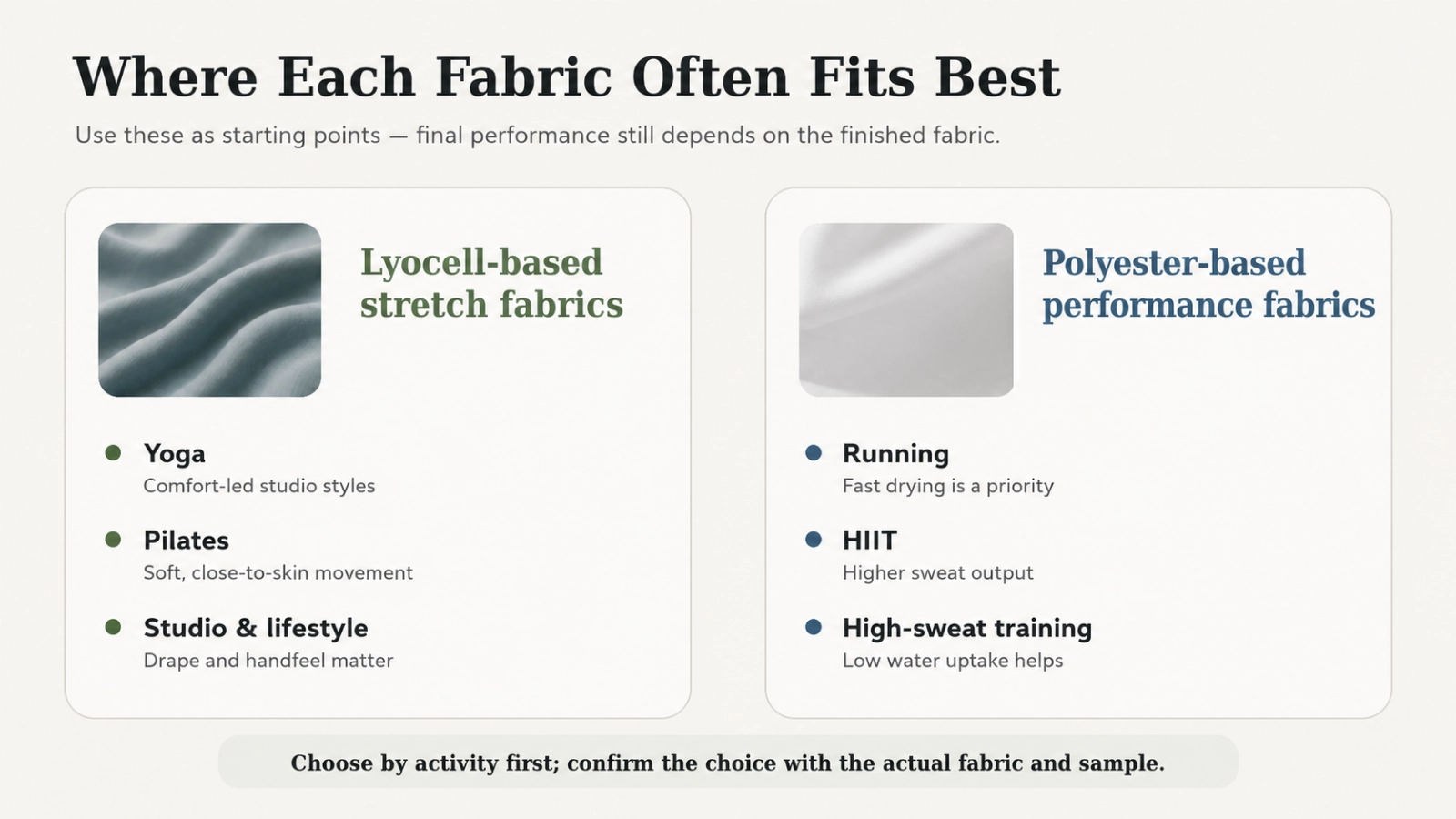 Lyocell-based stretch fabrics often fit comfort-led studio wear, while polyester-based performance fabrics are a stronger starting point when faster drying and high sweat output matter.
Yoga and Pilates
Studio apparel is one of the clearest use cases for Lyocell.
During yoga or Pilates, the fabric stays close to the body through repeated stretching and controlled movement. Maximum drying speed is rarely the only priority. Handfeel, comfort, coverage and freedom of movement matter just as much.
That combination makes Lyocell-based stretch fabrics a good candidate for soft yoga leggings, Pilates sets, flare pants, fitted tops and studio-to-lifestyle pieces.
For a practical example, our MZ-072 Lyocell Cotton Sports Tee uses a 170G blend of 47.5% Lyocell, 47.5% cotton and 5% spandex. It is designed for yoga warm-ups, light training and casual activewear, showing how Lyocell can be combined with cotton and stretch fiber when softness and everyday movement are higher priorities than maximum drying speed.
There is an important distinction here, though. A fabric containing Lyocell is not automatically a good legging fabric. Lightweight Lyocell jersey may be excellent for a top while lacking the opacity, recovery or structure required for fitted bottoms.
Hot Yoga
Once the room gets hotter and sweat output rises, the material has a harder job to do.
Comfort early in the session does not tell you how the fabric will feel after it has absorbed substantially more moisture. This is where the difference between moisture absorption and moisture release becomes more noticeable.
One small controlled study offers a useful directional signal. Researchers compared a 100% polyester sports shirt with a 67% polyester / 33% Lyocell shirt on 11 trained men. Under the tested conditions, the fabric containing Lyocell retained more water, and the researchers observed a potential thermoregulation disadvantage as sweat production increased.
Eleven participants and one shirt construction are nowhere near enough to settle the question for all activewear. The study also did not test yoga leggings. Even so, the result is useful because it illustrates a practical point: a fabric that absorbs more moisture does not automatically perform better once sweat levels become high.
For hot-yoga products, the final fabric should therefore be judged after it gets wet. Weight, drying behavior, recovery and wet handfeel become far more informative than the word “Lyocell” on a specification sheet.
Gym Training
Gym clothing sits somewhere between studio apparel and technical endurance wear.
A soft lifting top may benefit from the handfeel of Lyocell, while a firm training legging has very different requirements. Once stronger compression, repeated rubbing, heavier sweating and quicker drying become important, polyester starts to make more sense.
This is also why “best fabric for gym wear” is not really one question. The answer changes with the garment.
Running and HIIT
High-output exercise shifts the balance further toward polyester.
Running and sustained HIIT combine repeated movement with significant sweat production. Keeping water uptake low and allowing the fabric to dry quickly matter more here than they do in a gentle studio session.
That does not rule Lyocell out of every running product. A warm-up layer and a race-day top are solving different problems. But when the main requirement is to keep a garment relatively light and release moisture quickly through prolonged exercise, polyester is the more logical place to start.
For Leggings, the Fiber Name Tells Only Part of the Story
This is where many simple Lyocell vs polyester comparisons stop too early.
In product development, you are rarely choosing between “Lyocell” and “polyester” in isolation. You are comparing actual fabrics, such as a Lyocell/Elastane stretch knit against a Polyester/Elastane performance knit.
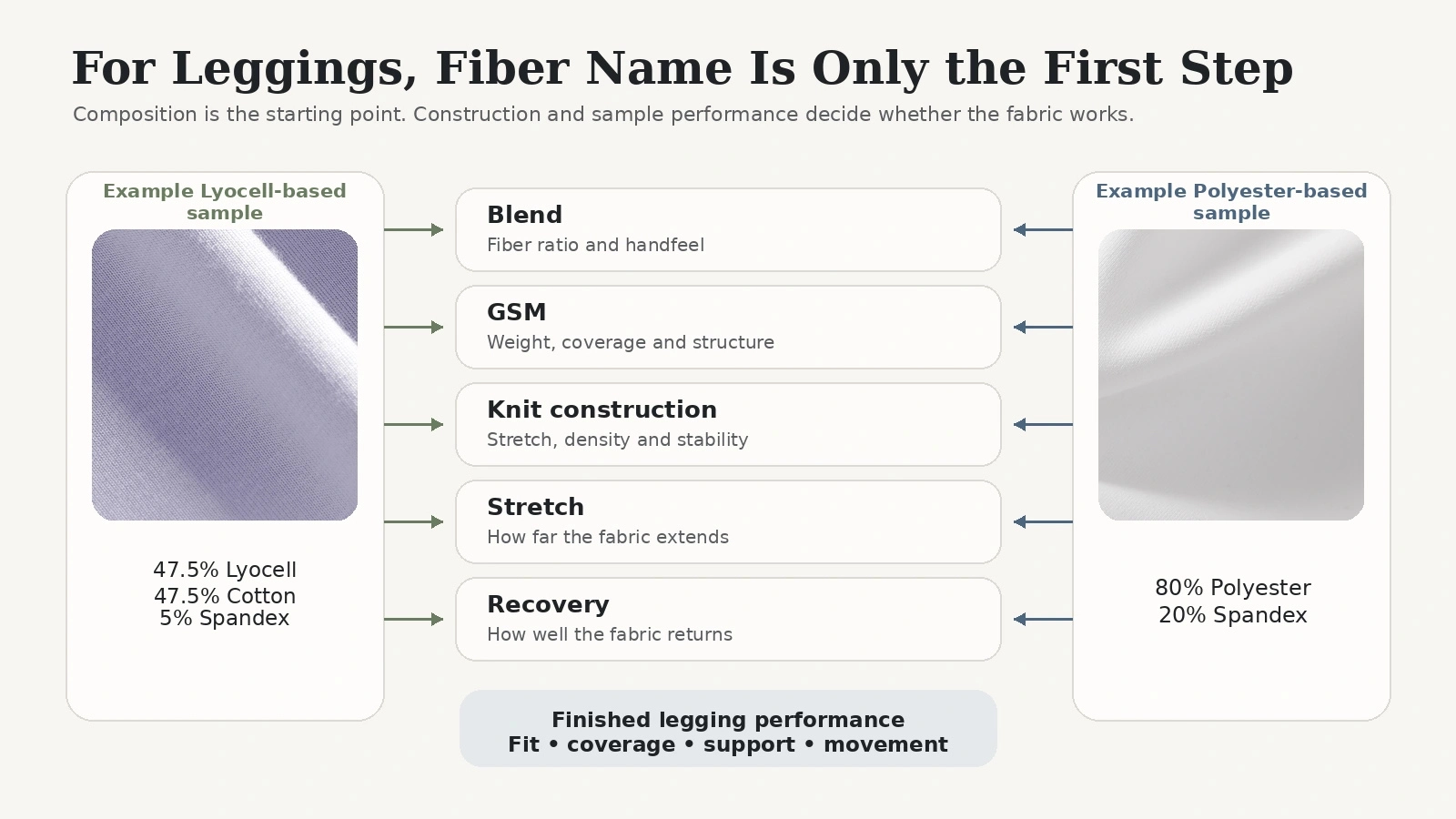 Fiber composition is only the starting point for leggings. GSM, knit construction, stretch and recovery also shape the performance of the finished fabric.
Once you reach that stage, several other variables begin to influence the result.
Blend
Fitted activewear needs controlled stretch and recovery. The main fiber is only one part of that system.
Elastane content, yarn combination and knit design all influence how far the fabric stretches and how well it returns. Two Lyocell fabrics can therefore produce very different leggings even when both are marketed under the same broad material name.
GSM
Fabric weight changes more than thickness.
Lighter constructions often feel fluid and comfortable, but they may provide less coverage or structure. Heavier fabrics can feel more substantial, although adding weight alone will not make a fabric supportive or squat-proof.
GSM belongs in the fabric specification. It should not be treated as a performance guarantee.
Knit Construction
Change the knit and the same blend can behave differently.
Stretch direction, surface feel, density, stability, breathability and wear resistance are all influenced by construction. Looking only at fiber percentages can therefore hide important differences between two candidate fabrics.
Recovery
Stretch catches attention during the first fitting. Recovery is what you notice after the garment has been worn.
If the fabric stretches easily but does not return well, loose areas can develop around the knees and the waistband can lose stability.
For leggings, both questions matter:
- How far does the fabric stretch?
- How well does it return after repeated stretching?
What Should Be Checked Before Fabric Approval?
Once the choice has narrowed to a few candidate fabrics, composition percentages are no longer enough. The sample has to prove that the material works in the intended garment.
For leggings and other fitted styles, check:
- fiber blend and knit construction;
- GSM;
- stretch direction and stretch level;
- recovery after repeated movement;
- opacity during bending and deep flexion;
- waistband stability;
- wet handfeel;
- drying behavior;
- surface condition after wear;
- shrinkage and dimensional stability after washing.

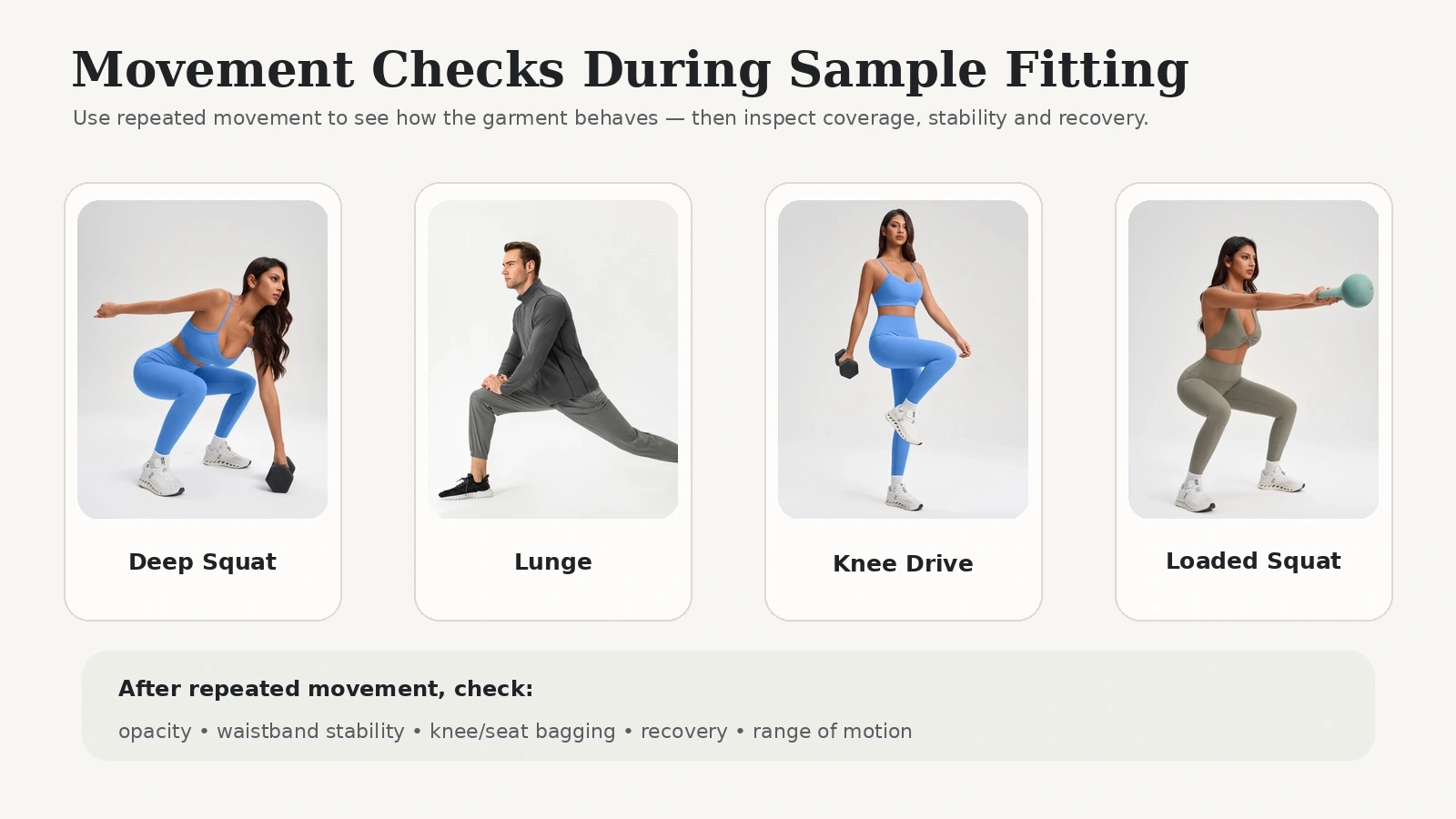 Movement during sample fitting helps reveal issues that are easy to miss on a hanger. After repeated movement, check opacity, waistband stability, bagging, recovery and range of motion.
Movement should match the product rather than follow one generic test routine. Bend, squat and stretch a yoga legging. For a high-sweat top, assess the fabric after it becomes wet instead of judging it only when dry.
That difference matters because a fabric can look excellent on a hanger and still fail once movement, moisture and repeated wear enter the picture.
Our activewear sampling process guide goes further into fabric, fit, opacity, recovery and construction checks before bulk production.
What About Sustainability and “Non-Toxic” Claims?
TENCEL™ and Lyocell are often discussed together with sustainability and textile safety. Those questions matter, but they should not be mixed into a simple performance claim.
TENCEL™ Lyocell starts with wood-derived cellulose, and Lenzing states that its closed-loop Lyocell process recovers 99.8% of the solvent used during production.
A finished activewear garment, however, is more than its main fiber. Elastane, sewing thread, prints, labels, dyes, trims and finishing treatments may all be part of the final construction.
For that reason, a garment containing Lyocell should not automatically be described as plastic-free, chemical-free, non-toxic or fully biodegradable.
For brand claims: describe the fiber accurately first. Broader environmental or chemical claims should match the complete garment specification and the documents that support it.
Polyester deserves the same level of accuracy. Calling the fiber itself “toxic” mixes the base material together with dyes, finishes and other production choices, which is too broad to be useful.
If restricted substances, chemical safety or specific certifications are part of your product requirements, include them separately in the fabric and garment approval process.
Lyocell vs Polyester: Which Should Your Brand Choose?
For yoga, Pilates and softer studio collections, start with a Lyocell-based stretch fabric when comfort, handfeel and a wood-derived fiber option fit the product.
For running, sustained HIIT and other applications where heavy sweating and faster drying dominate the brief, a polyester-based performance fabric is usually the stronger starting point.
Leggings need one more level of comparison. Before approving either material, look at the actual blend, GSM, knit construction, stretch, recovery and opacity.
That leads to a more useful question than simply asking which fiber is better:
Which finished fabric still does its job once it is made into the garment your customer will actually wear?
Developing a Lyocell or Polyester Activewear Style?
Share your target product, intended activity, preferred handfeel, support level, size range, reference design and expected quantity.
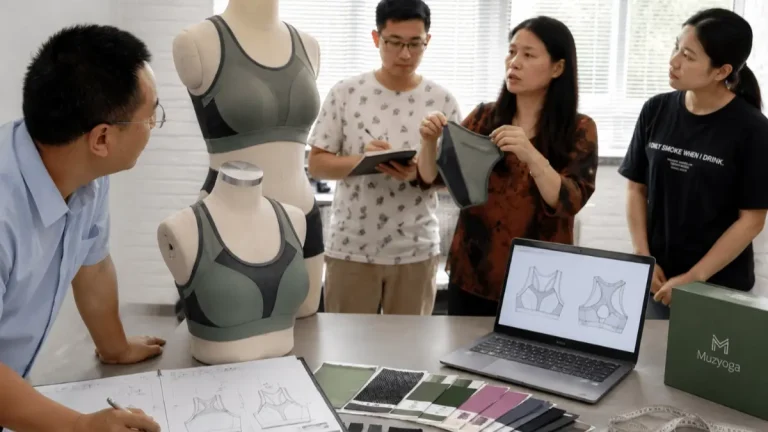
Muzyoga can compare suitable fabric options and develop a sample before the material is approved for bulk production.
Explore our custom OEM/ODM activewear development service
Frequently Asked Questions
Is Lyocell better than polyester for leggings?
For soft yoga and Pilates leggings, a well-developed Lyocell stretch fabric can work very well. When heavy sweating, faster drying or more performance-focused training becomes the priority, polyester may be the better starting point.
The final choice should still be based on the finished fabric. GSM, stretch, recovery, knit construction and opacity all affect how a legging performs.
Does Lyocell dry faster than polyester?
Usually not when rapid drying is the main goal. Lyocell takes moisture into the fiber more readily, while polyester absorbs relatively little water inside the fiber itself. Knit construction and finishing also influence how quickly the finished fabric dries.
Is TENCEL the same as Lyocell?
No. Lyocell is a generic fiber category. TENCEL™ is Lenzing’s fiber brand, which includes TENCEL™ Lyocell and TENCEL™ Modal.
Is Lyocell stretchy?
Lyocell itself should not be confused with elastane. Stretch can come from knit construction and from combining Lyocell with elastane or other stretch components.
For fitted activewear, the full fabric specification tells you much more than the word “Lyocell.”
Is Lyocell plastic?
Lyocell is a regenerated cellulosic fiber rather than a synthetic plastic fiber.
That does not mean every Lyocell garment is plastic-free. Activewear may still contain elastane, synthetic thread, labels, prints or other components.