Activewear Tech Pack Checklist: From Quote to Sample to Bulk Production
An activewear tech pack is the working production file that turns a design idea into instructions a manufacturer can quote, sample, revise and reproduce. It can start simple, but it has to become more specific as the product moves toward production.
You do not need every measurement, trim and fabric code finalized before the first factory conversation. You do need enough information for the next stage to have a clear target.
That creates three practical checkpoints:
- Before quotation: the manufacturer needs to understand what product it is pricing.
- Before sampling: the development team needs enough detail to build a sample that can be judged against a defined target.
- Before bulk production: the approved product needs one current specification that reflects the final sample.

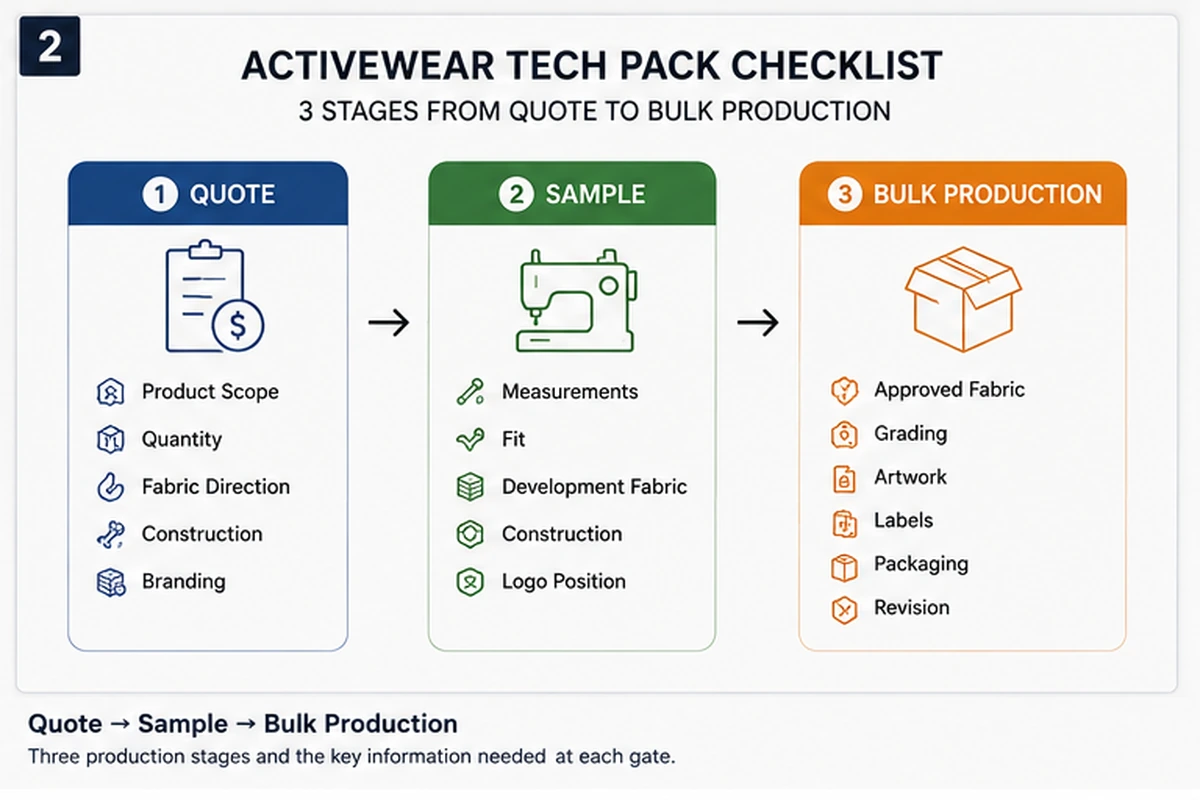
| Stage | What Needs to Be Clear | Main Question |
|---|---|---|
| Quotation | Product direction, quantity, size range, fabric direction, major construction, branding and packaging scope | Are suppliers pricing the same product? |
| First Sample | Sample size, measurements, fit intent, development fabric, construction details and branding position | Will you know whether the sample is right or wrong? |
| Bulk Production | Approved fabric, measurements, grading, construction, colors, artwork, labels, packaging and revision | Can production repeat the product you approved? |
Do You Need a Complete Activewear Tech Pack Before Contacting a Manufacturer?
No. You need enough information to explain what you are trying to develop and which decisions are still open.
This matters for startup brands because product development does not always begin with a finished technical file. You may have an existing garment you want to modify, a sketch, several reference images or an ODM style that is close to your idea.
Those materials are enough to begin a serious development conversation when you also explain the product direction.
For example, tell the manufacturer:
- what type of garment you are developing;
- the activity it is intended for;
- the fit and support direction;
- your planned size range;
- the expected order quantity;
- the number of colors;
- your branding requirements;
- which details you want to keep, change or develop.
A complete OEM project will eventually need much more detail. The difference is timing.
You can start the conversation before the tech pack is finished. You should not let an unfinished decision quietly become a production assumption.
What If You Only Have Reference Photos or an Existing Garment?
A reference product is a useful starting point, but it is not a manufacturing specification.
A photo shows appearance. It does not tell the factory the exact measurements, fabric, internal construction, stretch direction, pocket dimensions, waistband build or how the garment should fit on the body.
An existing garment gives the development team more information because it can be measured and its construction can be inspected. Even then, the factory still needs to know which parts are references and which parts you want changed.
Instead of sending a legging and saying, “Make something similar,” break the request into decisions.
For example:
- Keep the general high-waist silhouette.
- Remove the front seam.
- Add a side pocket.
- Use a softer fabric direction for yoga rather than firm compression training.
- Change the waistband height.
- Use your own logo, labels and packaging.
Mark those changes directly on photos or simple sketches where possible. If a detail is still open, say so clearly. The manufacturer can then propose a fabric, construction or measurement solution instead of guessing whether the missing information was intentional.
If you are still at the earlier stage of planning the collection, read our guide on how to start an activewear brand before building the technical file.
The practical distinction is simple: a reference starts the development conversation; a specification controls what happens next.
What Should Be Locked Before Requesting an Activewear Quote?
A quotation is useful only when the supplier understands the job it is pricing.
Two leggings can look almost identical in a front-view image while requiring very different development and production work. One might use an available fabric, simple seams and one heat-transfer logo. Another could include several panels, pockets, lining, custom fabric, multiple branding applications and retail packaging.
Before asking several manufacturers to quote the same project, give them the same basic scope.
Product and reference
Name the product clearly: leggings, shorts, sports bra, tennis dress, crop top, jacket or another defined style.
Attach the best reference available, such as a technical drawing, annotated image, physical sample or selected factory style.
Expected quantity and color plan
Give the expected quantity and indicate whether it is one color or several colorways. A quotation based on one simple color is not directly comparable with one that includes several material or color changes.
Size range
State the planned selling sizes and, if known, the size you want to use for development.
The full grading does not need to be complete at the first inquiry, but the manufacturer should understand whether the project is a narrow core-size range or a broader size program.
Fabric direction
If you already selected the fabric, include the available specification or swatch reference.
If you want the manufacturer to source options, describe the product outcome instead: softer yoga hand feel, firmer training support, brushed surface, lightweight second-skin feel or another clear direction.
Write manufacturer to propose when the fabric is deliberately open. Do not simply leave the field blank.
Construction that changes the job
Show the features that meaningfully change the garment:
- pockets;
- gussets;
- multiple panels;
- built-in bra construction;
- removable pads;
- zippers;
- lining;
- special waistbands;
- seamless knit zones;
- other visible structural details.
Branding and packaging scope
Tell the supplier what should be included in the quotation: logo application, main labels, size labels, care labels, hangtags, individual bags, barcodes or other retail packaging requirements.
This gives you a better basis for comparing suppliers.
Do not compare quotation totals until the main assumptions match. A lower quote is not automatically the better offer if it excludes parts of the product or uses a simpler material and construction assumption.
What Must Be Clear Before the First Activewear Sample?
Once sampling starts, the job changes. The factory is no longer estimating your idea. It is building the first physical version.
At this point, your activewear tech pack needs enough detail to answer one question after the sample arrives:
Did the factory make what we asked for?
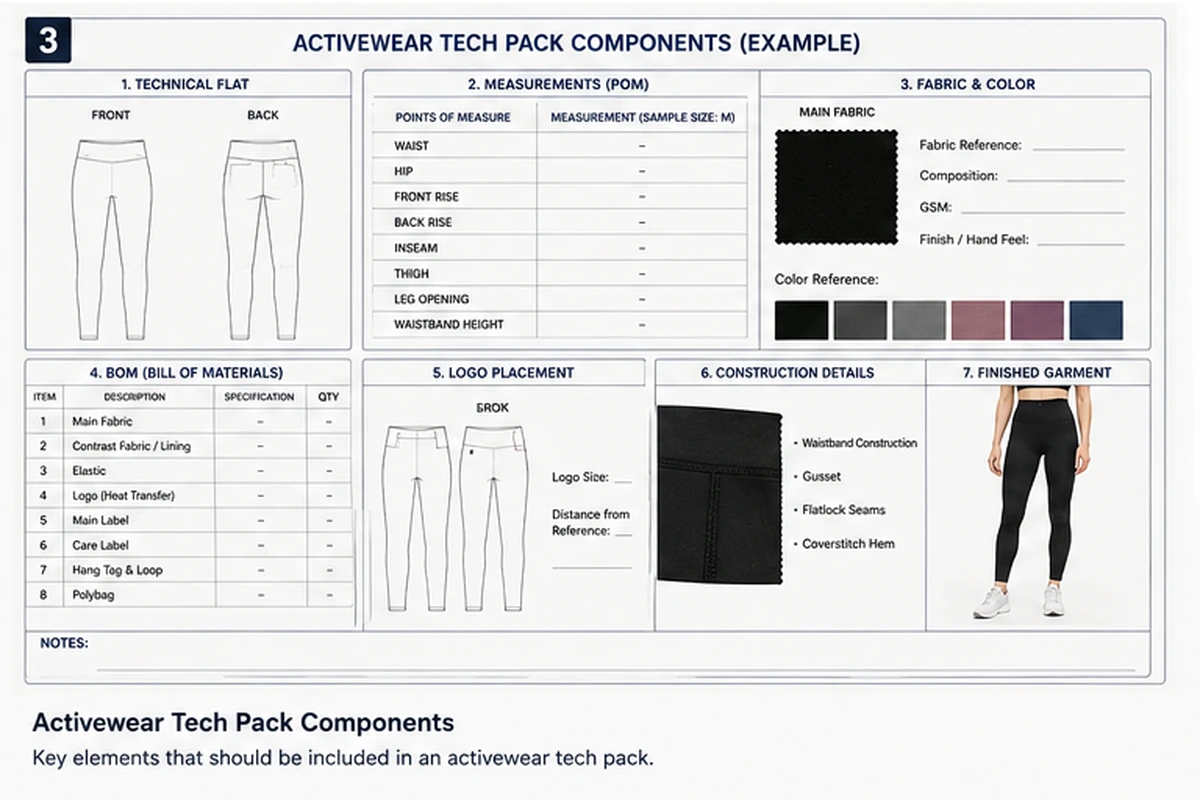
Show the garment from the views that matter
Front and back technical views are the normal starting point. Add side, internal or enlarged detail views where they explain something that cannot be understood from the outside.
If you are still working from photos, annotate those photos. Point to the pocket opening, waistband, neckline, panel, strap or hem you are discussing instead of relying on a long message beside an unmarked image.
Define the sample size and points of measure
The measurement chart should identify the sample size and the important points of measure (POM).
A number without a measurement method creates room for interpretation. Waistband width, rise, inseam, sports-bra underband and body length need defined start and end points so the sample can be checked the same way by both sides.
The first development sample does not have to resolve every size in the range. It does need a clear base-size target.
Explain the intended fit
A description such as “premium fit” or “very supportive” sounds useful but gives the pattern maker little direction.
Describe the actual wearing target.
Should the legging feel soft enough for studio yoga or firmer for strength training? Should the waistband stay flat during bending? Is the sports bra intended for light studio support or a more secure training feel? Is the silhouette relaxed, close-fitting or deliberately compressive?
These descriptions do not replace measurements. They explain what the measurements and construction are trying to achieve.
Identify the fabric used for development
Record the fabric selected for the sample using the information available, such as:
- fabric code or swatch reference;
- fiber composition;
- GSM;
- surface or finish;
- color reference;
- stretch direction;
- the performance requirement that matters to the style.
A phrase such as “use the soft black fabric we discussed” becomes difficult to control once a project contains several samples, colors or styles.
For fitted leggings, the final decision should not come from a fabric swatch alone. The finished sample shows how the material behaves once it is stretched over the body. Our squat-proof leggings sample testing guide goes deeper into opacity, waistband stability, fit and movement checks.
Document construction and branding
The tech pack should show the product details that affect how the garment is made: waistband construction, gusset, lining, pocket structure, pads, straps, panel joins, hems, closures and relevant seam routes.
Branding also needs more than “logo on left hip.”
Record the artwork, decoration method, finished size and position from a consistent seam or measurement reference.
Before the first sample begins, you should be able to point to the file and explain what the sample is expected to prove.
What Makes an Activewear Tech Pack Different From a Basic Clothing Tech Pack?
A standard garment tech pack already covers measurements, materials and construction. Activewear adds another layer because the product has to work while the fabric stretches and the body moves.
That does not mean filling the file with textile-engineering terminology. It means documenting the product decisions that movement can change.
Fabric needs a performance direction
Fiber composition is useful, but the same fiber percentages do not automatically create the same wearing experience.
For activewear, the specification should also communicate the characteristics that matter to the style: stretch direction, recovery, surface feel, coverage, weight direction and intended support.
If a requirement has not yet been translated into a technical number, describe the product outcome clearly and keep it as a development item.
“Soft, four-way stretch fabric for low-to-medium support yoga leggings” gives the sourcing team more direction than “premium stretchy fabric.”
Fit needs to be connected to movement
A garment can look correct while standing and behave differently during squats, lunges, bends or overhead movement.
For leggings, the development brief may need to address waistband hold, rise, crotch comfort, gusset shape, opacity and recovery.
For sports bras, the important fit points change to the underband, neckline, armhole, strap position and pad placement.
The product type and activity therefore belong in the technical discussion, not only in the marketing description.
The manufacturing route changes what needs to be specified
Cut-and-sew activewear is built from fabric panels that are cut and joined. Seamless activewear creates much of the garment body through yarn and programmed knit structures before final sewing and finishing.
For a seamless legging or sports bra, the development file may therefore need to communicate waistband height, rib sections, mesh placement, contour zones and other knitted structures rather than treating the garment like a standard panelled style.
Our guide to the seamless activewear manufacturing process explains that manufacturing route in more detail.
The useful rule here is not “add more technical terms.” It is: document every product decision that the manufacturing team needs in order to reproduce the intended fit, structure and appearance.
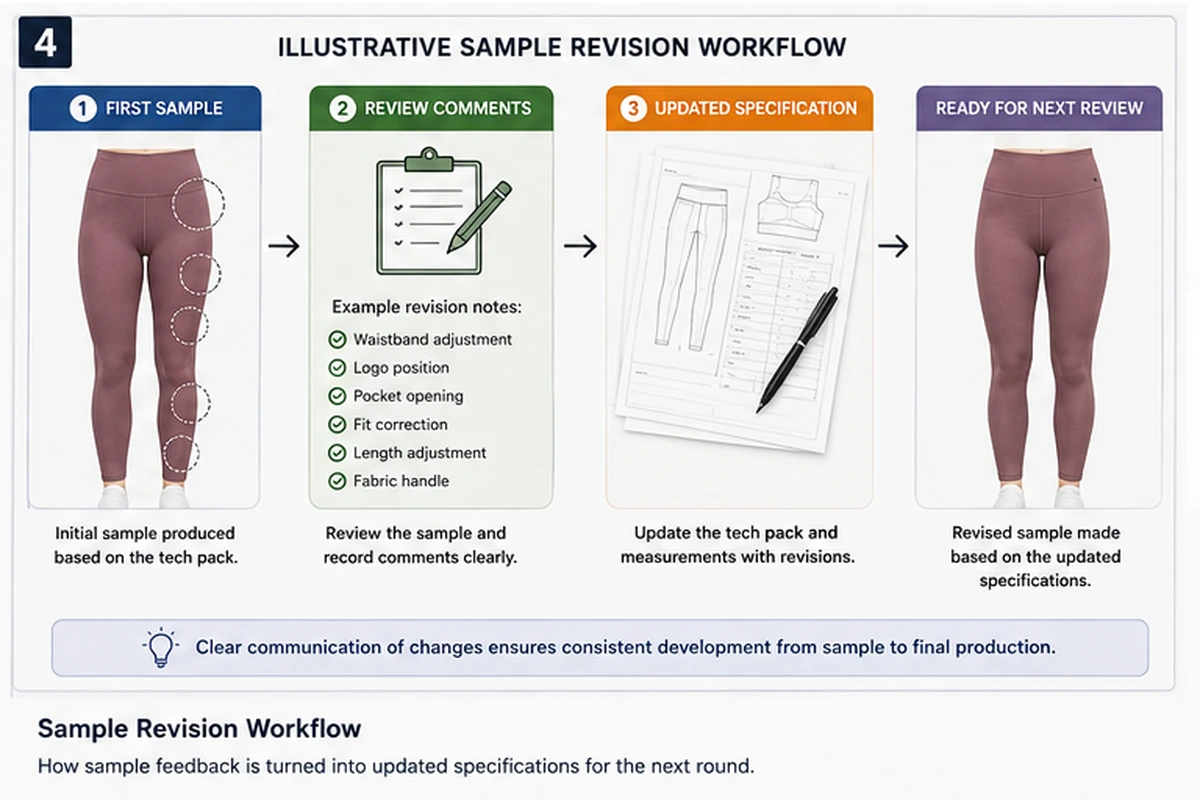
How Should the Tech Pack Change After the First Sample?
The first sample is not the end of the tech pack. It is the point where assumptions become visible.
You might discover that the waistband is too loose, the rise is too short, the logo sits too low when worn, a pocket opening is difficult to use or the fabric does not give the intended level of support.
The important step is turning those observations into updated production instructions.
A weak sample comment says:
“The waistband is too loose.”
A stronger revision identifies the affected measurement or construction point and records the approved change.
A weak branding comment says:
“Move the logo higher.”
A stronger revision records the new position from an agreed seam or measurement reference while keeping the artwork size and method clear.
Use the same process for fabric, straps, pockets, seams, trims and other details:
- identify what was reviewed;
- state the requested change;
- update the affected drawing, BOM or measurement;
- issue a new revision;
- record the approval status.
Do not let the latest version of the garment exist only across an old PDF, several emails and a message thread.
Once a change is approved, move it into the current product specification.
This is what turns sample feedback into a production reference instead of a collection of comments.
What Must Be Frozen Before Bulk Production?
Bulk production needs one current version of the product.
Before the order is released, compare the latest specification with the sample you actually approved.
The production file should reflect the agreed:
- main fabric, lining, elastic and trims;
- fabric and color references;
- base-size measurements;
- size grading;
- waistband, gusset, panel, pocket and seam construction;
- logo artwork, decoration method, size and placement;
- main label, size label and care-label requirements;
- hangtags and other branding components;
- folding and individual packaging;
- current revision number or date;
- approved sample reference.
If the physical sample changed but the tech pack did not, the two references now disagree. That should be corrected before production starts.
Old options and rejected versions should also be removed or clearly superseded. The production team should not have to reconstruct the history of the project to decide which instruction is current.
Bulk production should not run from an old tech pack plus newer verbal instructions.
Activewear Tech Pack Checklist by Production Stage
Before requesting a quotation
- Product category or style name
- Technical sketch, reference images or reference garment
- Notes showing what to keep, change or avoid
- Expected order quantity
- Number of colorways
- Planned size range
- Fabric direction or fabric reference
- Major construction features
- Logo and branding scope
- Label and packaging scope
- Open decisions clearly identified
Before authorizing the first sample
- Front, back and necessary detail views
- Sample size
- POM measurement chart
- Measurement method
- Fit and activity direction
- Development fabric or approved fabric option
- Bill of materials (BOM) for the sample
- Construction notes
- Logo artwork, method, size and placement
- Specific questions the sample is expected to answer
Before approving bulk production
- Final approved fabric and trim references
- Final color references
- Approved base measurements
- Approved size grading
- Final construction
- Final logo artwork and decoration specifications
- Final labels and packaging
- Latest revision number or date
- Approved production-reference sample
- No unresolved change that affects the finished product
The practical rule:
Your first message to a manufacturer does not need every production detail. Your quotation needs enough information to price the intended product. Your first sample needs enough information to judge the result. Bulk production needs one approved specification that matches the product you signed off.
Frequently Asked Questions About Activewear Tech Packs
Do I need a tech pack before contacting an activewear manufacturer?
No. You can begin with a reference garment, annotated images, sketches or a partial product brief. Tell the manufacturer what you want to keep, what you want to change and which decisions are still open. More detailed specifications should be added before the stages that depend on them.
What should be included in an activewear tech pack?
A production-ready activewear tech pack normally brings together product drawings, materials, measurements, construction, colors, branding, labels, packaging and revision information. Activewear also needs clear direction for the fit, movement and fabric performance that matter to the specific product.
Can an activewear manufacturer create a tech pack from reference images or samples?
A manufacturer that provides product-development support can work from references and help translate them into fabrics, measurements, construction and sample specifications. The brand still needs to make the product decisions: which features to keep, how the garment should fit, who it is designed for and which changes are acceptable.
What is the difference between a tech pack and a spec sheet?
A spec sheet mainly records garment measurements, measurement methods and related tolerances. A tech pack is broader. It connects the drawings, bill of materials, measurements, construction, artwork, colors, labels, packaging and revisions needed to manufacture the style.
When is an activewear tech pack ready for bulk production?
It is ready when the current file matches the product that was approved. Final materials, measurements, grading, construction, colors, artwork, labels and packaging should be recorded, and unresolved changes that affect the finished garment should be closed before production begins.
Developing a custom activewear style?
Muzyoga supports OEM/ODM development for leggings, sports bras, yoga wear, fitness apparel and related activewear products.
If you already have a tech pack, send the current file together with your target quantity and branding requirements. If your project is earlier in development, send reference products, sketches or marked-up images instead.
Send your activewear project requirements to Muzyoga